How to Repurpose 1 Podcast Into 30 Pieces of Content
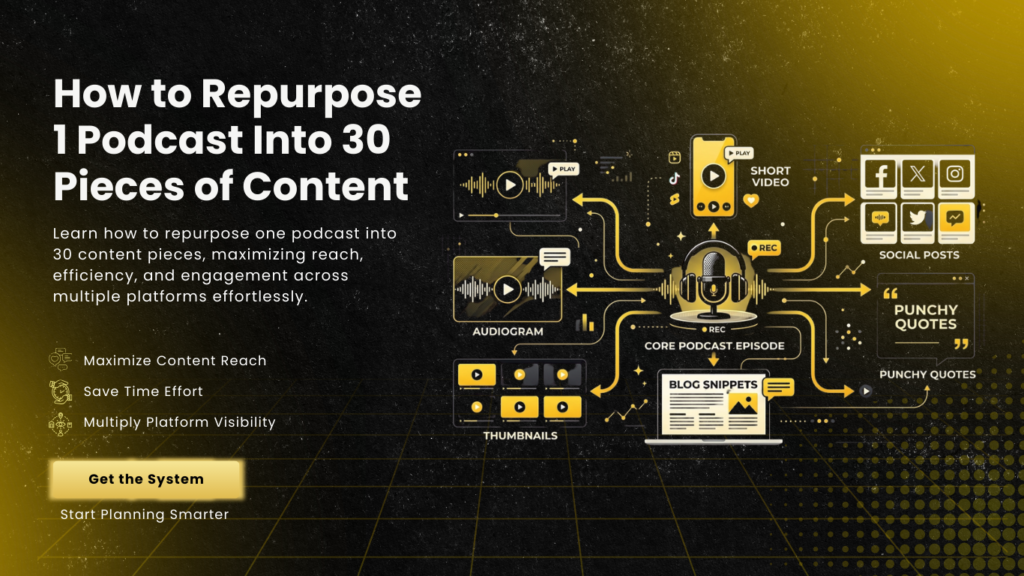
Podcasts are one of the most content-rich formats available to creators, entrepreneurs, coaches, and brands in 2026. With over 580 million global monthly listeners, 73% of Americans having consumed a podcast in some form, and YouTube now confirmed as the world’s most-used podcast platform with over one billion monthly viewers the opportunity has never been bigger. Yet most creators still post a single episode and move on, leaving an enormous amount of value on the table.
Podcast content repurposing is the strategy of transforming one recording into dozens of distinct content pieces across multiple formats and platforms. Instead of spending hours creating brand new material every day, you extract maximum value from content you have already produced. Done systematically, podcast content repurposing lets you reach audiences who prefer video, short clips, written articles, social graphics, or newsletters all from a single episode. This guide breaks down exactly how to do it, updated for 2026’s multi-platform, video-first podcasting landscape.
Why Podcast Content Repurposing Has Become Essential in 2026
Podcast content repurposing has evolved from a nice-to-have tactic to a core operational strategy. Several major 2025–2026 shifts make this more important than ever:
Video podcasting is now the default. By early 2026, Apple Podcasts joined YouTube and Spotify in supporting video episodes meaning every major podcast platform now treats video as a core feature. 64% of new podcast consumers prefer video first, and 41% of all listeners now actively prefer video podcasts over audio-only. If you are recording a podcast without a podcast content repurposing plan, you are missing the majority of potential audience touchpoints.
YouTube is the #1 podcast platform. Edison Research’s 2025 Infinite Dial report confirmed YouTube is now used most often for podcast consumption by 33% of weekly listeners ahead of Spotify at 26% and Apple Podcasts at 14%. This means podcast content repurposing into YouTube-optimised video formats is no longer optional for growth.
Multi-format campaigns drive 23% higher ROI. Cross-channel content strategies using both video and audio consistently outperform single-format approaches. One well-produced episode, repurposed intelligently, feeds your entire content funnel building authority, driving discovery, and converting audiences across every platform simultaneously.
Step 1: Identify Your Key Segments Before Repurposing Anything
Effective podcast content repurposing starts before you open your editing software. Listen back through the episode and mark the moments that will travel furthest across formats:
- Quotable insights: Sharp, standalone statements that work as graphics or caption hooks
- High-value tips: Actionable advice that works as short-form video content
- Stories and anecdotes: Narrative moments that perform well on YouTube and longer-form platforms
- Controversial or surprising statements: Pattern-interrupt moments that drive engagement on TikTok and Reels
- Step-by-step explanations: Structured content ideal for blog posts, carousels, or email breakdowns
Mapping your segments first means every podcast content repurposing decision is intentional — not random. Aim to identify at least 8–10 distinct segments per episode, which forms the foundation for your 30+ pieces.
Short-Form Video Clips (Pieces 1–10)
Short-form video is the single highest-leverage output in any podcast content repurposing workflow. Extract clips between 30 and 90 seconds that capture a standalone idea, a memorable quote, or a compelling story moment. Each clip gets edited and formatted separately for:
- TikTok — vertical 9:16, animated captions, hook in the first 1.5 seconds
- Instagram Reels — same vertical format, slightly different caption style and hashtag approach
- YouTube Shorts — optimised title, keyword-rich caption, up to 3 minutes now supported
- LinkedIn Video — slightly longer clips (60–90 seconds) tolerated, professional framing preferred
- Facebook Reels — repurposed from the same vertical edit with platform-native text
From 8–10 identified segments, you can realistically extract 2–3 clips per segment with different hooks or framing giving you 8–10 distinct short-form videos per episode across platforms. These short-form clips function as samples: they are often the first interaction a new viewer has with your show, drawing them towards the full episode.
Long-Form Video Content (Pieces 11–12)
The full episode, professionally edited, represents two distinct long-form outputs in your podcast content repurposing plan:
Full YouTube Upload: The complete episode with clean audio, smooth cuts, polished transitions, and visual elements such as lower-thirds identifying speakers, chapter timestamps, and keyword-rich description. YouTube’s chapter markers are now an algorithmic asset they help the platform understand your content and surface it in search.
Website Embed / Show Notes Video: A version hosted directly on your website or podcast landing page, paired with full show notes. This drives SEO, keeps visitors on-page longer, and provides a reference resource that other sites may link to building domain authority over time.
Blog Post and Written Content (Pieces 13–15)
Transcription-based podcast content repurposing turns audio into SEO-driving written content. AI transcription tools like Castmagic, Descript, or Riverside now make this faster than ever generating a rough transcript in minutes that you edit for readability.
From one episode you can produce:
- A long-form blog post (1,500–2,500 words) covering the episode’s core topic with headings, examples, and internal links — your primary SEO asset
- A condensed summary article (500–800 words) covering the key takeaways for readers who want the highlights without the depth
- A LinkedIn article reframing the episode’s core argument specifically for a professional audience with relevant industry angle
Written content from podcast content repurposing creates organic search entry points that audio and video alone cannot achieve reaching audiences who discover content through Google rather than social feeds or podcast apps.
Quote Graphics and Visual Pulls (Pieces 16–19)
Every podcast episode contains shareable moments that work perfectly as standalone visual content. Pull 4–6 of your strongest quotes or insights from the episode and design them as branded graphics for:
- Instagram static posts — high-contrast, readable, brand-consistent
- LinkedIn graphics — slightly more professional aesthetic, work well with a short caption providing context
- Facebook and Pinterest — evergreen graphics with episode links in captions
- Twitter/X — text-forward quote cards with your handle and episode number
Quote graphics are one of the fastest outputs in a podcast content repurposing workflow. They require minimal production time but drive consistent engagement particularly on LinkedIn and Instagram, where saves and shares signal high value to the algorithm.
Social Media Carousels (Pieces 20–21)
Carousel posts transform your podcast’s structured content lists, step-by-step frameworks, or tip roundups into multi-slide interactive posts. Each slide covers one point, building towards a payoff that encourages saves and shares.
Carousels work exceptionally well on Instagram and LinkedIn as a podcast content repurposing output because they require viewers to actively swipe through, generating meaningful engagement signals that both platforms reward algorithmically. A single episode’s tips or framework can generate one Instagram carousel and one LinkedIn carousel formatted and captioned differently to suit each platform’s audience.
Email Newsletter Content (Pieces 22–23)
Your email list is one of the highest-value distribution channels for podcast content repurposing because it reaches an audience that has already opted in and demonstrated trust. From one episode you can produce:
- A full episode newsletter: A 400–600 word summary of the episode’s key insights, broken into scannable sections with a clear CTA to listen or watch the full episode
- A standalone insight email: One specific idea from the episode expanded into a short standalone piece great for list segments who may not listen but will read a valuable insight
Email podcast content repurposing drives direct traffic to your episode, strengthens subscriber relationships with consistent value, and keeps your show top-of-mind between publishing dates.
Infographics and Visual Summaries (Piece 24)
Complex frameworks, processes, or data discussed in the episode can be distilled into a shareable infographic. This is particularly powerful for educational, business, or technical podcast content where the ideas benefit from visual representation. Infographics are highly shareable, perform well on Pinterest and LinkedIn, and can be embedded in your blog post making them a multi-purpose asset within your podcast content repurposing system.
Mini-Episodes and Audio Clips (Pieces 25–26)
Long-form episodes can be split into standalone mini-episodes for your podcast feed. Identify 1–2 segments that function as complete, self-contained ideas and publish them as bonus episodes or standalone releases on Spotify, Apple Podcasts, and other platforms. This is standard podcast content repurposing practice among high-volume shows — it increases your episode count, gives algorithm-surfacing more opportunities, and reaches listeners who prefer shorter listens.
Community and Engagement Content (Pieces 27–28)
In 2026, the most effective podcast growth strategies include building community around episodes — not just broadcasting them. Two high-value community content outputs per episode:
- A discussion post: Share a provocative question or controversial statement from the episode on your private community platform (Discord, Slack, or a membership forum), asking members to weigh in. This drives engagement between episodes and builds the kind of active community that platforms increasingly reward.
- A poll or interactive story: Use the episode’s core question or debate as an Instagram Story poll, LinkedIn poll, or YouTube Community post — driving interaction and signalling content relevance to the algorithm.
Repurposed Content for LinkedIn and Vodcast Clips (Pieces 29–30)
Two final high-value outputs complete your 30-piece podcast content repurposing system:
- A LinkedIn thought leadership post: Take the episode’s most counterintuitive or insight-rich moment and write a 150–300 word LinkedIn text post around it — no graphic needed. LinkedIn’s algorithm rewards native text posts with strong first-line hooks, making this one of the fastest-growing organic reach formats on the platform.
- A vodcast highlight clip for connected TV: As video podcasts increasingly reach audiences through YouTube on television screens YouTube accounted for 12.5% of total US streaming time in October 2025 a longer 3–5 minute highlight segment optimized for on-screen viewing (larger text, clear framing, chapter-style structure) serves the growing audience watching podcast content on their TV rather than their phone.
Building a Repeatable Podcast Content Repurposing System
The difference between creators who occasionally repurpose and those who consistently generate 30+ pieces per episode is a repeatable system. The most effective podcast content repurposing workflows in 2026 follow a simple structure:
Record once → Transcribe immediately → Identify segments → Assign formats → Batch edit → Schedule distribution
AI-powered tools now handle significant portions of this workflow. Tools like Opus Clip identify high-retention clip moments and predict virality scores. Castmagic turns recordings into transcripts, show notes, and social post drafts. Repurpose.io auto-distributes content to 30+ destinations. Human editors then handle the quality layer ensuring every piece is polished, on-brand, and genuinely platform-optimised rather than just auto-generated.
The key operational principle: treat podcast content repurposing as a production pipeline, not an afterthought. Every episode should enter the repurposing workflow on the day of recording.

Why Choose Prime Edits Ltd
Prime Edits Ltd specialises in end-to-end podcast content repurposing transforming single episodes into comprehensive content libraries that drive discovery, build authority, and grow audiences across every major platform.
Their team handles professional video editing, short-form clip extraction, animated captions, audio enhancement, graphics creation, blog formatting, and platform-specific optimisation. Rather than leaving creators to repurpose manually or rely entirely on automated tools, Prime Edits Ltd provides the human editorial layer that ensures every piece of repurposed content is genuinely compelling not just technically formatted.
By partnering with Prime Edits Ltd, creators and brands can implement a scalable podcast content repurposing system that maximises the return on every hour of recording time, without burning out their team or sacrificing quality.
Conclusion
Podcast content repurposing in 2026 is no longer a growth hack it is the operational backbone of any serious content strategy. With YouTube as the world’s dominant podcast platform, video now supported on every major listening app, and multi-format campaigns delivering 23% higher ROI than single-format approaches, the creators who scale fastest are those who build systematic repurposing into their workflow from day one.
One episode. Thirty pieces. Audiences reached across video, audio, text, social, and email each discovering your content on their preferred platform, in their preferred format. Partnering with a specialist like Prime Edits Ltd ensures your podcast content repurposing system is built for consistency, quality, and long-term growth.
FAQs
What is podcast content repurposing and why does it matter in 2026?
Podcast content repurposing is the process of transforming one episode into multiple content formats short videos, blog posts, graphics, newsletters, carousels, and more for distribution across different platforms. In 2026, with YouTube as the #1 podcast platform and video now supported everywhere, a systematic repurposing strategy is essential for maximising reach and ROI from every recording.
How many pieces of content can I realistically get from one podcast episode?
A single well-structured episode can generate 30 or more distinct pieces of content: 8–10 short-form video clips, 2 long-form videos, 3 written pieces, 4 quote graphics, 2 carousels, 2 email newsletters, 1 infographic, 2 mini-episodes, 2 community posts, and 2 platform-specific long-form posts. The exact number depends on episode length and segment variety.
Do I need AI tools for podcast content repurposing?
AI tools like Opus Clip, Castmagic, and Descript significantly speed up transcription and clip identification handling 40–70% of the mechanical work. However, human editorial judgement remains essential for ensuring each piece is genuinely engaging, on-brand, and optimised for its specific platform and audience.
Is video podcast content repurposing more valuable than audio-only?
Yes. 64% of new podcast consumers prefer video first, and video clips consistently outperform audio audiograms for social media discovery. With all major platforms now supporting video podcasts, repurposing video content delivers significantly more reach and engagement than audio-only formats.
How does Prime Edits Ltd help with podcast content repurposing?
Prime Edits Ltd handles the full podcast content repurposing pipeline video editing, short-form clip extraction, animated captions, audio enhancement, graphics creation, and platform-specific formatting ensuring every piece of repurposed content is polished, engaging, and built to perform on its target platform..